Tuesday, February 21, 2012

Benesse Art Site on Naoshima

View from Benesse House
Inland Sea
Win and Pumpkin

17 February 2012

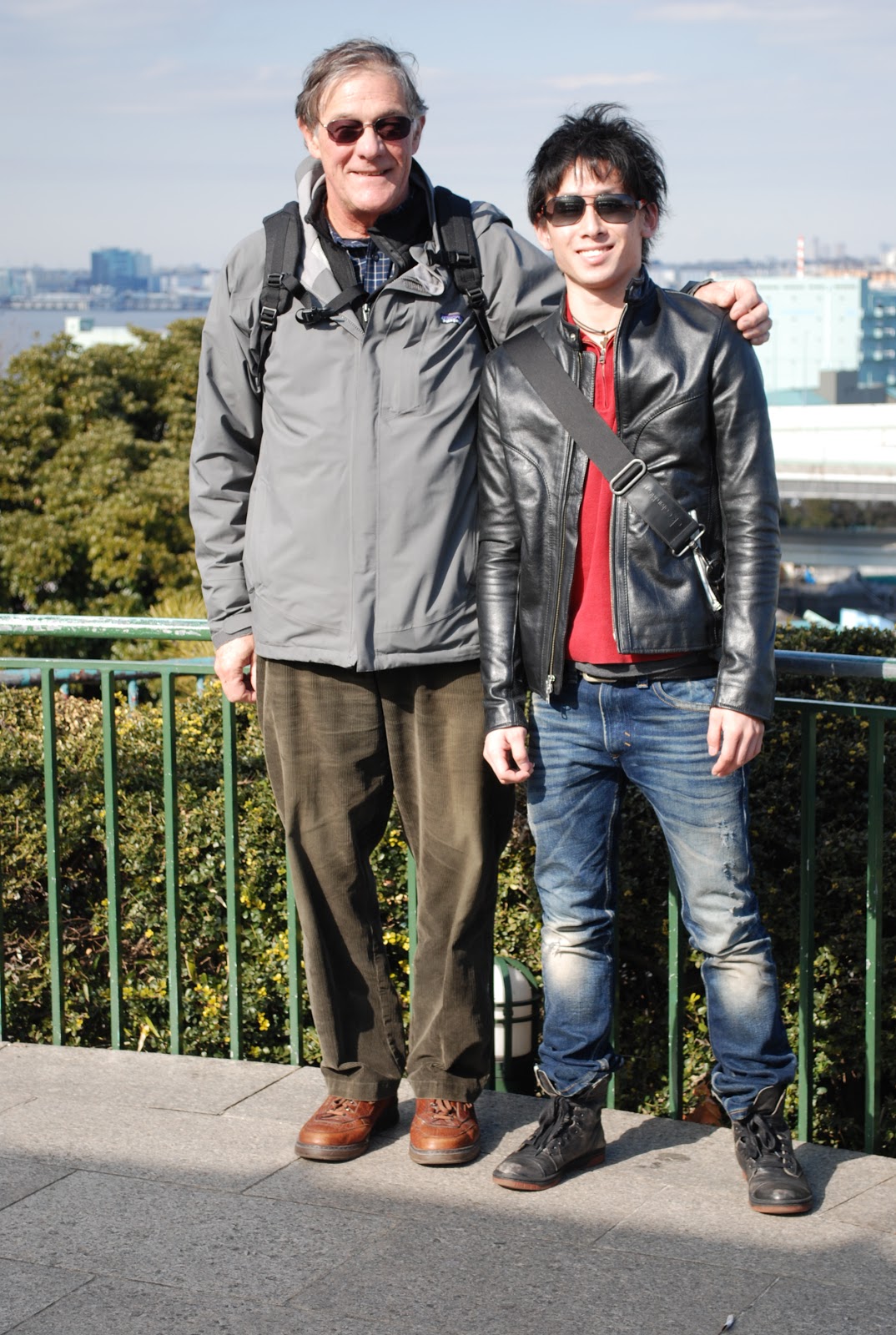
On 2/17 we left Kyoto for our journey to the Inland Sea (Seto naikai), inspired by Donald Richie's book, The Inland Sea, and a general longing for salt air.  We traveled by train to Uno via Okayama.  At Uno, we took a short ferry ride to the island of Naoshima, where Benesse Art Site is located.  Benesse is a spectacular and quite unique blending of wonderful architecture, art works of many sorts, and a naturally magnificent setting.  The hotel sits seamlessly in the middle of it all.  There are numerous art projects on Naoshima and neighboring islands.  On Naoshima we explored first the Art House Project.  In the village of Honmura, about six old houses have been restored and transformed into works of art, each by a different artist.  In one house there were large paintings on all four walls resembling water falls, in another walls that looked sometimes like a wild sky and sometimes like a wild sea.  Another had a dark, bath like space with small blinking electric light numbers floating about like aquatic fire flies.  It is hard to do it all justice with words.  Back at Benesse House Park, we found our beautiful room looking over a park and the sea.  Beautiful pieces of art inside and out adorn the house and grounds.   The amusing pumpkin sits on a small dock and is perhaps the iconic image of Benesse.  Win posed in the Japanese fashion.

The next stop was the Benesse House Museum, with a small but wonderful collection, each piece in a space that seems specially created to show it best.  In the photograph above (not mine - no inside photography allowed) is Jennifer Bartlett's "Yellow and Black Boats".  Then dinner in the museum, a lovely, refined Kaiseki meal including 8 small courses served in beautiful dishes.  The soup was "oyster minced and steamed [like a soft dumpling], carrot, spinach and thin-sliced turnip".  The grilled dish was "butterfish broiled with salted entrails of sea cucumber [!!], and salad".  You get the idea...There appears to be nothing dwelling in the sea that Japanese won't eat in one form or another.

The next morning, after an excellent breakfast, we visited the Chichu Museum, mostly underground but with marvelous sculptural spaces and day light coming in from everywhere.  Inside and outside seem intertwined...Aside from the architect, there are only three artists shown in the museum: Monet, James Turrell, and Walter De Maria.  Do visit this museum someday, if you possibly can, to see the five late Monet waterlily paintings hung in a vast white room, lit only by naturally changing day light.  Words fail, but the physical sensations remain when I think of it.

Unfortunately we did not have time to see the Lee Ufan Museum or bathe at the whimsical Naoshima Bath (see first photo).  We took the ferry in the midst of a snow storm to Takamatsu on Shikoku for the next part of our short journey.

 We feel so grateful to Darcy Bacon for suggesting the trip to Benesse!

Love to all

Monday, February 20, 2012

Dinner en famille

11 February 2012

We went to Yokohama to see our old friend from 20 years ago, Junko, and to meet Junko's mother and her younger sister Ritsuko.  We were given a huge dose of Japanese graciousness and "over the top" generosity. Junko came to our hotel and took us to her mother's house in a taxi.  The house was about average size by Japanese standards, in the suburbs of Yokohama, which means that small  farms are still around.  Most of the farmers have too little land left in agricultural use, in such locations, to make a living off it, but they often rent out housing they have built on the rest of their land, and continue to farm small bits as a sideline.

As soon as we had entered the house, taken off our shoes, and exchanged bows with Mrs. Inokuma and Ritsuko, we were asked to come and "say hello" to her husband.  I half expected to see an elderly man in bed, but, in the room, there was a photograph of a distinguished parliament member, looking in his 70's, and, next to the picture was a small alter with some greenery and incense.  Then I remembered that Junko's father had died.  I'd forgotten when, but was reminded that it was about five years ago.  We knelt at the alter, bowed with our hands together, and lit incense sticks which we left burning in a tray of sand.  Mrs. Inokuma beamed and said she knew he was very glad to meet us.

Then we went upstairs in our slippers.  The "family" room is cozy and small.  It has not only the dining table, and all the books and DVDs, but the "big screen" as well.  There is no central heating in most Japanese houses, but there are electric space heaters and, if you move under the warm comforter that is under the dining room table, and stick your feet into the clandestine foot well (it looks as though you are sitting on the floor, with your legs tucked behind you, as if you were a proper Japanese, but only you and your hosts know that you are "cheating"), you will stay warm.  I even took off my jacket, whereupon the patriarch's  honored sweater was brought out and put over my shoulders.

Japanese people are not fond of conversation, so,  before dinner,  Junko had us do calligraphy, which is a quasi-ceremonial thing people do to welcome in the New Year.  We see endless possibilities, and have already bought beginners' sets for use at home.  Then came dinner which was an endless number of small and large dishes, some Western, and most Japanese.  I couldn't, and won't list them.  The evening was sentimental to a degree we aren't used to, but to which we responded like kids.

When we left, we weren't allowed to pay for the taxi home.  We learned from Junko, who has risen in the government and is now working internationally to attract other Asian investment to Japan, and Ritsuko, who is a journalist, expert in Japan's  problems with the "greying" of its population, about "giri", and "ninjo", which consider the inter-weaving of the emotions related to "gratitude" and "obligation" and emotions related to "generosity" and "dependent intimacy". 

Tuesday, February 14, 2012

Yokohama

Win and Yusuke-san
Training ship Nipponmaru from the ferris wheel
Intercontinental Hotel and Yokohama port from the ferris wheel
Enoshima Island
Hands of the Great Buddha, Kamakura
Junko-san, B, Ritsuko-san, W in front of the Great Buddha
13 February 2012

We set out by train for Yokohama Saturday morning, arriving uneventfully at the Intercontinental Hotel in Minato Mirai just before noon.  Junko's mother had made the arrangements herself, having decided our original choice of hotel would not give us the correct impression of the city.   Well, you really can't beat the view from a large window on the 26th floor looking out over Yokohama Harbor!  Mirato Mirai is the extensive water front development in Yokohama, which makes Boston seem like a small town in comparison.   Yusuke, a student Win had met on the plane in Dec picked us up at the hotel, and we went out to lunch and had a whirlwind tour of the city, including the waterfront, Chinatown (the largest in Japan), and the foreigners' cemetery, dating back to the early 20th century.  In the late afternoon, Junko met us and brought us to her mother's home for dinner.  This was such a memorable occasion that it will be a separate entry.

Sunday was clear, sunny and remarkably warm.  With Junko and Ritsuko, we took the train to nearby Kamakua, an old seaside town of temples, shrines and tourists.  We visited the Hachiman-gu Shrine, a nearby garden with a gorgeous display of blooming peonies, and then the statue of the Great Buddha (Daibutsu), cast in 1252 and a survivor of fire, earthquakes, tidal waves etc.  It seems to have an eternal calm.  After this we had lunch and then took the old train to catch the old boat to Enoshima Iwaya Cave facing Sagami Bay and Fujisan in the distance.  It is said that the caves lead to Fujisan; also that the legend of a heavenly maiden and a terrible dragon originated in the cave.  In any event, it was fun to walk along the rocky shore and walk into the caves holding a candle to keep from knocking one's head.  I think these were places Junko and her sisters visited frequently as children. 
We had a wonderful Chinese dinner (incuding shark fin soup, Peking duck) at a restaurant in Yokohama, all arranged by Seiko-san (their mother). 

Monday we decided to take a turn on the ferris wheel, one of the largest in Japan (takes about 15min to go around once).  I thought it would be terrifying, but the day was calm and the motion mercifully minimal.  The maritime museum was unfortunately closed, so we peeked into the nearby CUPNOODLES MUSEUM, dedicated to Momofuku Ando, a clever man who alone invented ramen packets in 1958 and went on to make his fortune with Nissin food products, most especially cupnoodles.  At the museum, you can make your own individual package of cupnoodles with your own label and flavors and also make noodles - looked like fun but we didn't do it...very entertaining!

Then back to Kyoto.

Love from both of us-

Monday, February 13, 2012

The Moss Temple and The Cricket Temple

Moss Garden at Saiho-ji
Bell Crickets and cage


10 February 2012

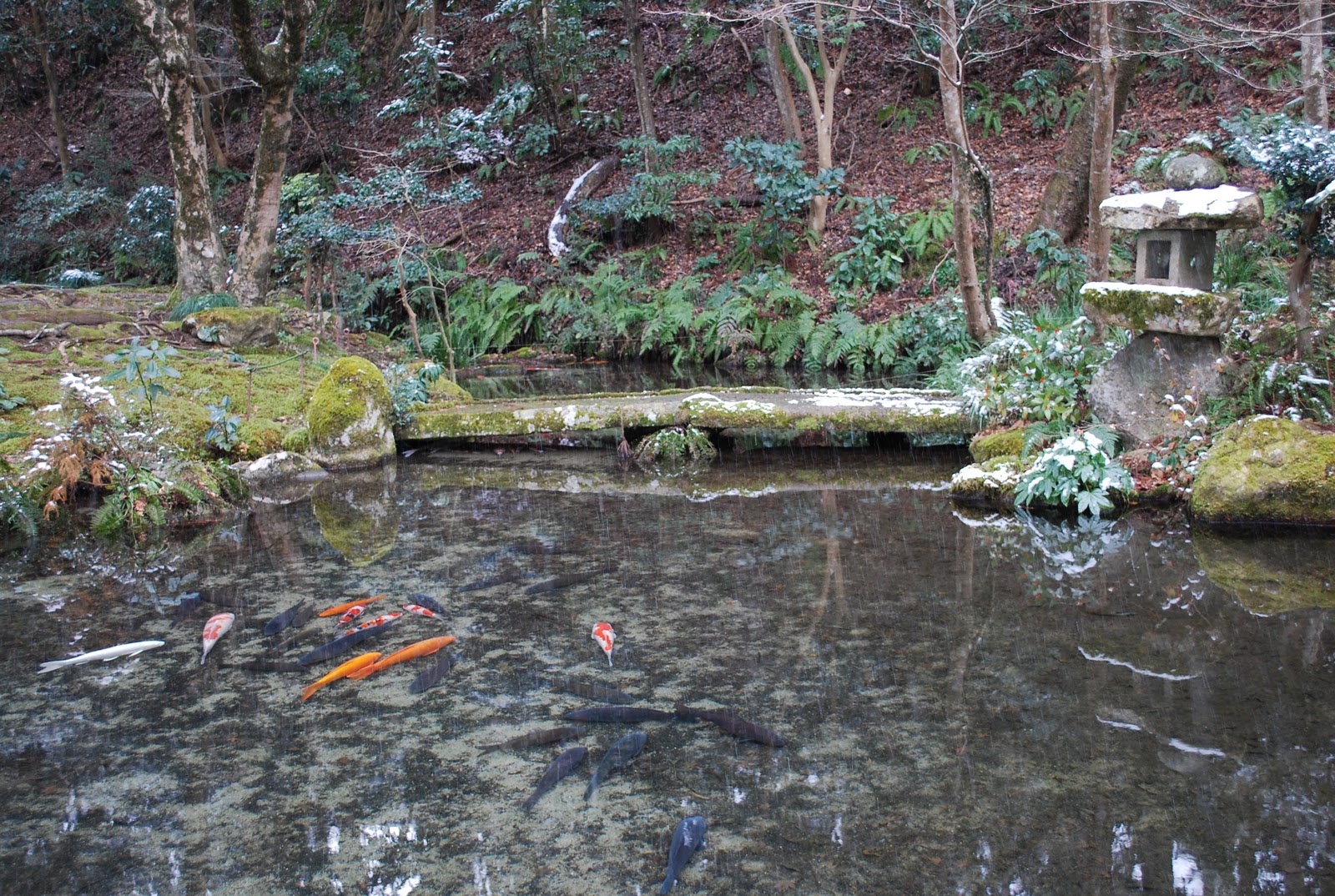
Having written ahead to the monks at Saiho-ji (the Moss Garden Temple or Koke-dera), we received permission to visit on the 10th (a requirement for all visitors due to the need to limit the number of people and buses in the area of the moss garden).   Since we arrived early, we were able to have a nice lunch in a nearby, very ancient soba noodle shop (this time some sort of foamy arrangement on top of the soup plus and egg yolk).  The temple is a many centuries old Zen temple.  After being let in, visitors first recite sutras with a monk, and then write a wish on a wooden board (the man next to me, speaking to me in English, suggested with a twinkle in his eye that I just write I hope to be rich, but I thought it more appropriate to express a more compassionate sentiment).  When the ceremony was over, we were able to walk through the beautiful, peaceful garden.  The pond is shaped like the Chinese character for "heart".  Apparently the original gardens designed in the 14th century,  fell into disrepair and were eventually covered by moss, now very much treasured.  There are said to be 120 species of moss growing there.  Even in winter, it is quite green - the softness of the moss and the many shades of green lend a quiet and gentle feel to the landscape.

We had an hour or so before the return bus was to leave, so we wandered around the area and up a long flight of worn stone steps, finding ourselves in a small crowd entering a temple called Suzumushi Temple.  Suzumushi means cricket, and the priest who founded this temple was inspired by the summer song of the bell cricket, and determined to keep the song year round.  Thus crickets were raised and nurtured inside the temple and indeed can be heard loudly all year round singing from their cages.  While they sing the priest delivers a talk to the audience who relax and enjoy tea and a sweet.  It is said that the Kofuku Jizo (or happy Jizo) whose statue is outside, will deliver one wish to each person if he knows your wish and your address.  That is why he has straw sandals on his feet.  So lots of young people come to this temple to make wishes about jobs, success in school, marriage etc.  This is one example of why wandering around Kyoto is such a joy!

We send love and wish you could hear the crickets too, B&W


Friday, February 3, 2012

Oni wa soto; fuku wa uchi! (Oni begone; good luck come in!)


Yasaka Shrine - Setsubun in the snow


Geisha about perform at Yasaka Shrine

Oni pelted with beans
Hokusai print of Oni pelted with beans (mame)
Fuku mame (Happiness beans)
Mamemaki (throwing beans at the Oni)

3 February 2012
Setsubun

http://www.youtube.com/watch?feature=player_embedded&v=C_4m5HJsC9o#!

On February 2 and 3, Setsubun festivals took place in Japan, both in temples and shrines and in homes.  Setsubun (lunar calendar spring) is a time of casting out bad spirits and demons (called Oni), and bringing in good fortune.  It is an ancient tradition, and at some of the temples and shrines resembles something that is a blending of a serious pilgrimage for Japanese people and a carnival, complete with stalls lining the streets and walkways selling marvelous (mostly) foods of every sort (especially sardines),  little games for children, fortunes and other temple paraphernalia, even cotton candy and candied apples and oranges.  There are a lot of things demons don't like which include: foul smells and sharp needles (hence fish heads impaled on holly leaves), smoke (hence bonfires at temples in which New Year's decorations and wishes are burned), arrows, and most especially mame (beans).  The tradition is to throw roasted soy beans at the Oni (or the person in a family pretending to be an oni),  and out the doors and windows of your house shouting "Oni wa soto; fuku wa uchi!" In schools small children make Oni masks, etc, and you can buy them with the beans.  People also eat long (uncut) nori maki rolls while facing Northwest and not speaking (I'm not sure about the exact significance of this...).  Much of this information came from Araki-sensei.

On Thursday, a cold and intermittently snowy day, I visited the Yasaka Shrine in the afternoon where there were performances of musicians, geisha etc every hour (see first two photos).  After each performance small packets of fuku mame were thrown out to a very enthusiastic (and cold) audience.  I think beans acquired at the shrine are especially significant...Wanting to warm, I went into what I thought was a tea tent, but what was served turned out to be Amazake which is a sweet drink made of fermented rice (a bit thick and milky and warm with little rice bits and a pinch of ginger).  Just what I needed to warm up!

Thursday evening we went to the Yoshida Shrine with Berg and Somdev, our American friends in this apartment.  We ate various street foods and then at 6pm went to the short drama of scaring of the oni being acted out while priests read prayers.  Couldn't see much but the sound effects were excellent.  The above youtube address is a 4 minute clip which is excellent (other than the moment when the oni actually scares a small child, though mostly kids are having a great time).  You can cut and paste it...  It definitely conveys the night scene!  Also shows the next day when people go to pray at the sub shrine up the hill.

Finally, on Friday, we went together to the Mibudera temple to see a famous Noh comedy (Kyogen play) having to do with Setsubun.  The characters wear wonderful masks and the action depicted through stylized gestures and dance (no dialog), with a gong, drum and flute punctuating the story.  We were sitting outdoors which was pretty nippy.  I learned later that the play concerned the greed of an old lady visited by an Oni in disguise, and in the end she loses her greed and chases him away by pelting him with you know what...No photographs allowed unfortunately.

I think this is more than enough information.

Oni wa soto; Fuku wa uchi!  Love, B&W


Tuesday, January 31, 2012

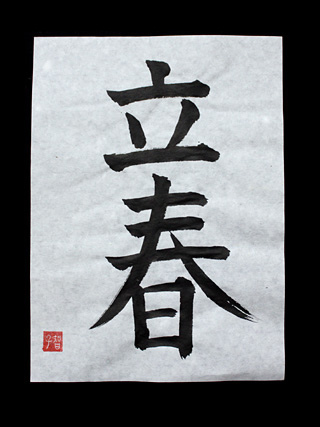
Snow Poems for Risshun (Lunar calendar spring)

risshun - start of spring
Woodblock of snowman


30 January 2012

There is only an occasional and temporary dusting of snow in Kyoto, but from where we live we can see snow up in the surrounding hills.  Though it definitely feels like winter, February 3 is Risshun or the change from winter to spring according to the lunar calendar, celebrated in Japan by festivities called Setsubun, which I will describe in the next entry. In the meantime, while it is still winter (and I imagine it will be for some weeks to come in spite of the celebrations), I will copy out a couple of Japanese winter poems just for enjoyment:

you make the fire
and I'll show you something wonderful:
a big ball of snow!

          -Basho


Fresh morning snow in front of the shrine.
The trees!  Are they white with peach blossoms
Or white with snow?
The children and I joyfully throw snowballs

           -Zen monk Ryokan (1758-1831)


Sunday, January 29, 2012

Snow in the Hills

Protection for young Cherry Trees
Woodblock of a traditional costume from Ohara
Ohara


29 January 2012

About a half hour bus ride into the hills north of Kyoto lies the old farming town of Ohara.  We decided that in spite of our colds and the chilly weather we would set off.  Quite a change from Kyoto.  Our first stop was the beautiful Pure Land temple, Sanzen-ji.  Gardens are lovely and tranquil in winter, sharpened by snow, and made pleasing and colorful by many sorts of red berries, camellias, mosses, rocks, reflections in the ponds.  Walking through the temples in winter can seem like a sort of penance in that one's sock-clad feet become increasingly frozen.  The first four photos give you some idea of the gardens (and the sweet straw shelters for young cherry tree saplings).  We then found a nice warm place for lunch, and had one of Kyoto's specialties - yuba in a soup which I guess is mostly soy milk or gruel, served in a little wooden tub.  Plus ten or so other little bits of things and of course a bowl of rice - always!  Good to warm up.

Thus fortified, we walked across the road and up the hill to the town, which was mostly deserted.  The woodblock shows the traditional costume worn by women from this area.  The photo (not mine) shows the town (and rice paddy) in summer and gives you some idea of how the town looks.


We are hoping the Republicans self-destruct.

Much love, B&W